


At this year’s ENFSI Fingerprint Working Group, hosted by the Mossos D’Esquadra, regional police of Catalonia, Spain, the conversation focused heavily on Shortwave Reflected Ultraviolet Imaging , a powerful fingermark visualisation technique known for its ability to significantly reduce background interference.
The Historic Challenge of RUVIS Adoption
Despite RUVIS’s potential to deliver exceptionally high-contrast fingermarks on challenging non-porous surfaces, its widespread adoption has been historically hindered. Of the over 100 European fingermark experts in attendance, only a handful actively employ the technique, with many citing long-standing barriers:
DNA Degradation Risk: Shortwave UV-C radiation is known to degrade potentially valuable DNA evidence.
Operator Safety: Concentrated UV-C presents an occupational hazard to the operator’s skin and eyes.
Performance and Ergonomics: Early RUVIS instruments were often ‘clunky’, difficult to operate, and frequently failed to consistently deliver the promised high-resolution, high-contrast results required for modern forensic analysis.

DCS 6 Redefines RUVIS Capability
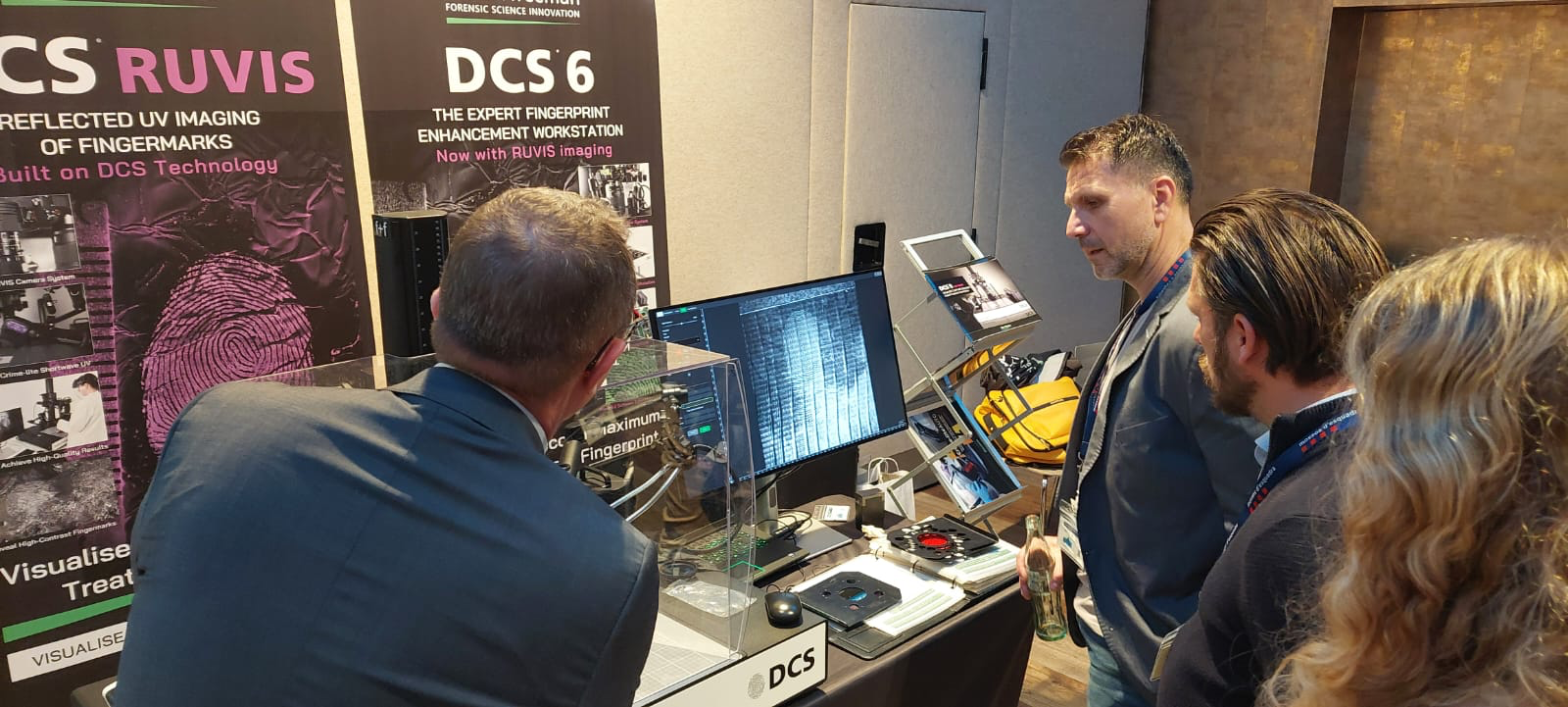
However, RUVIS was a top agenda item amongst the ENFSI group, following the introduction of the latest iteration of foster+freeman’s industry-leading fingermark imaging system: the DCS 6.
DCS 6 is the first system in the series to integrate a dedicated Shortwave RUVIS module. This solution directly addresses the historic drawbacks by combining advanced, specialised optics and high-resolution imaging to deliver:
AFIS-Quality Resolution: Dedicated RUVIS optics solve the issues of low-resolution imaging common with earlier systems.
Improved Operator Safety: Using a handheld, and highly directional UV 280nm LED light source, the system is inherently safer to use when compared with early 254nm mercury lamps. Operators need only equip themselves with standard Personal Protective Equipment (long-sleeved lab coat, gloves, and face mark or visor), to manage the risk associated with UV-C exposure.
Workflow Integration: By including the module within a high-end, professional forensic workstation, the DCS 6 enables precise workflow management complete with tamperproof audit trail.
During the ENFSI event, foster+ffeeman presented proprietary research collected during the development of DCS 6, demonstrating its capability to deliver AFIS-ready fingermarks using this specialised technique. This was followed by a series of live demonstrations, introducing working group members to a system poised to make RUVIS a standard, viable tool for forensic laboratories throughout the region.
About Foster + Freeman DCS 6:
The DCS 6 is a complete digital fingerprint imaging workstation, re-engineered to set a new standard for fingermark visualisation, capture, and digital enhancement. It delivers technical excellence in every aspect of the forensic process, backed by secure ITD (Image Tamper Detection) integrity. www.fosterfreeman.com/dcs-6/
About ENFSI-FPWG:
The European Network of Forensic Science Institutes (ENFSI) Fingerprint Working Group (FPWG) brings together European experts to foster collaboration, standardise methodology, and share best practices in fingermark examination.